Wall Art Placement Calculator
The 357 rule helps you hang wall art at perfect eye level. This calculator shows where to position the center of your artwork based on room conditions.
How to Use This Calculator
Enter your measurements below. The calculator will show you exactly where to hang your artwork according to the 357 rule.
Wall Art Placement Calculator
Choose your situation to get accurate placement instructions.
Placement Instructions
Enter your measurements to see placement instructions.
Ever stood in front of a blank wall, holding a painting, and just… felt it was off? Like it was floating, too high, too low, or just didn’t belong? You’re not alone. That’s where the 357 rule comes in. It’s not magic. It’s not complicated. It’s just a simple, tried-and-true method used by interior designers to make wall art look balanced, intentional, and naturally part of the room.
What Exactly Is the 357 Rule?
The 357 rule is a guideline for where to hang artwork or decorative pieces on a wall. It says: aim to have the center of your art at 57 inches from the floor. That’s about eye level for most adults. It’s not about the top or bottom of the frame - it’s the center point.
Why 57 inches? Because that’s the average height of a person’s line of sight when standing in a typical room. Think about how you look around a space. You don’t stare at the ceiling or the baseboard. You scan at chest-to-shoulder height. That’s where your eyes naturally land. Hanging art at 57 inches means people see it the way it was meant to be seen - not craning their necks up or bending down.
This rule works whether you’re hanging one large piece, a pair of canvases, or a gallery wall. It doesn’t matter if it’s a landscape, a photo, a mirror, or a decorative plate. The center stays at 57 inches.
Why Does This Matter?
Think about the last time you walked into a hotel lobby or a friend’s living room. Did any of the art feel awkward? Maybe it was too high, like it was floating above the sofa. Or maybe it was too low, buried under the edge of a console table. That’s what happens when you guess.
Art that’s hung too high looks disconnected from the furniture. It feels like it’s on a different planet. Art that’s too low looks cramped. It doesn’t breathe. The 357 rule fixes both problems. It creates a visual anchor. It ties the wall to the room.
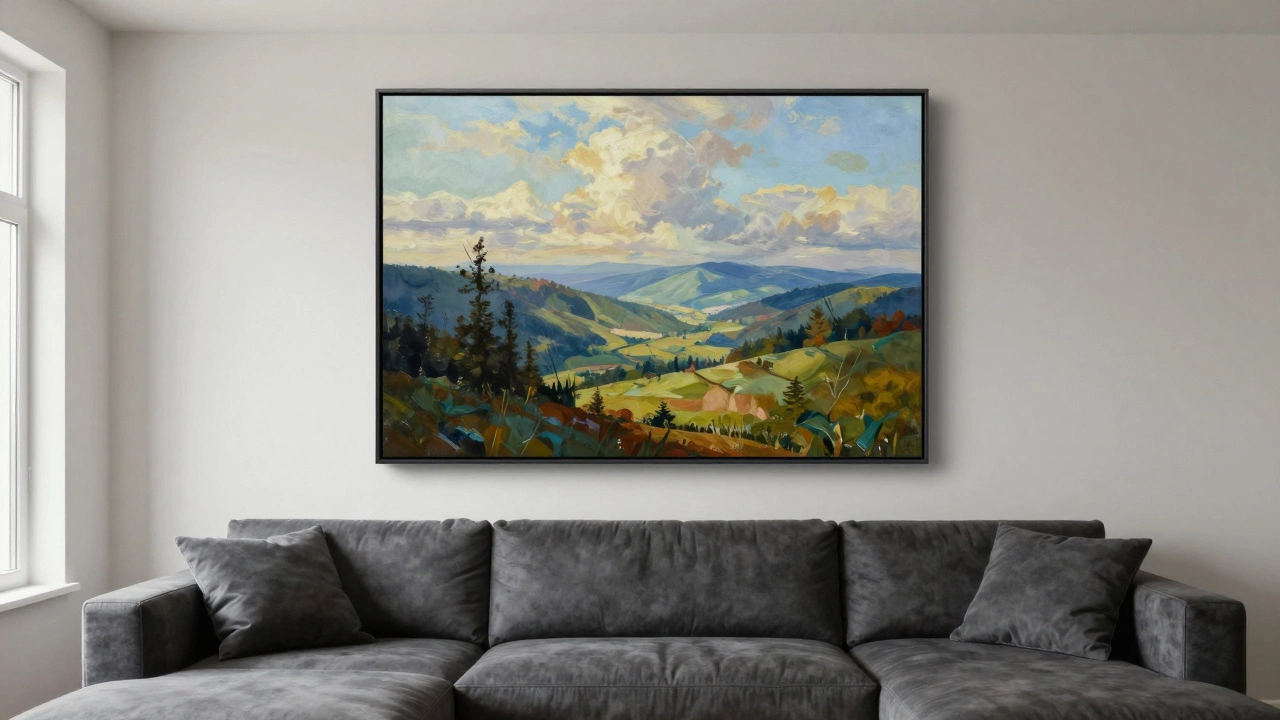
Here’s a real example: In a living room with a sectional sofa, the back of the sofa sits about 18 inches off the floor. If you hang art with its center at 57 inches, the bottom of the frame ends up roughly 39 inches above the sofa. That leaves a clean 18-inch gap - enough space to feel intentional, not empty. That’s the sweet spot.
What About Furniture Below the Art?
This is where people get confused. If you’re hanging art above a sofa, a console table, or a bed, should you still use 57 inches?
Yes - but with a twist.
The 357 rule still applies to the center of the artwork. But you also need to consider the furniture underneath. The standard advice: keep the bottom of the art piece 6 to 8 inches above the top of the furniture. That’s enough space to visually separate the two elements without making the art look like it’s floating away.
So here’s how to do it:
- Measure the height of your sofa, bed, or console table. Let’s say it’s 18 inches tall.
- Add 7 inches (the middle of 6-8). That gives you 25 inches from the floor to the bottom of your frame.
- Measure the height of your artwork. Say it’s 24 inches tall.
- Half of that is 12 inches. So the center of the frame is 25 + 12 = 37 inches from the floor.
- Wait - that’s way below 57. What’s going on?
Here’s the key: if you’re hanging art above furniture, you don’t force the center to 57 inches. You use the 6-8 inch rule above the furniture, and let the center fall where it may. The 57-inch rule is for walls with no furniture underneath - like a hallway, above a fireplace, or in an empty corner.
So to clarify:
- Art over furniture? Use 6-8 inches above the furniture.
- Art on an empty wall? Use 57 inches from the floor to the center.
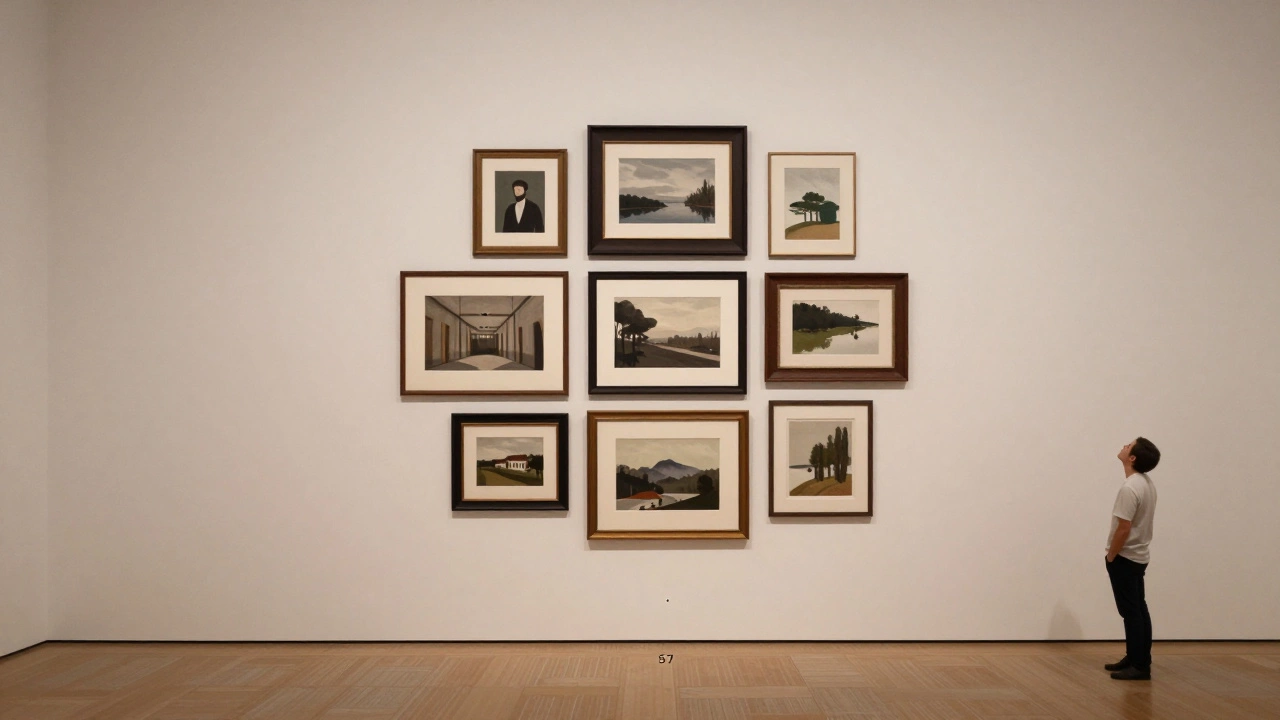
What If You Have Multiple Pieces?
Gallery walls? Grouped frames? The 357 rule still applies - but to the whole group.
Here’s how:
- Arrange your frames on the floor first. Tape them together or lay them out in the pattern you want.
- Measure the total height of the group. Find the center point of the entire arrangement.
- Mark that center point on the wall at 57 inches from the floor.
- Hang the whole group so that center point lines up with your mark.
That means if you have a 5-piece grid that’s 48 inches tall, the center is 24 inches from the top or bottom. You hang it so that 24 inches from the bottom of the lowest frame is at 57 inches - meaning the bottom of the lowest frame is at 33 inches from the floor. The top of the top frame will be at 81 inches. That’s fine. The group as a whole is centered at eye level.
Don’t hang each frame individually at 57 inches. That creates chaos. Group them. Treat them like one big piece.
What About Taller or Shorter People?
You might be 6 feet tall. Or 5 feet. Does the rule still work?
Yes - because 57 inches isn’t about you. It’s about the average. Designers use 57 inches because it works for most people in most rooms. It’s not a personal rule. It’s a universal one.
Think of it like a door handle. They’re placed at 36 inches even though some people are taller or shorter. It’s about usability for the majority. Same here. If you’re really tall or short, you might notice it’s a little off. But for guests, visitors, and most viewers? It’ll look perfectly balanced.
And if you’re hanging art in a child’s room? Then adjust. Lower it. Maybe 48 inches. But in adult spaces - living rooms, hallways, dining rooms - stick with 57.
Common Mistakes to Avoid
- Hanging art too high - This is the #1 mistake. People think “higher = more important.” It’s not. It just looks lonely.
- Ignoring the furniture - Art over a sofa shouldn’t float. It should feel connected.
- Measuring from the top of the frame - Always measure from the center. The frame’s shape doesn’t matter. The center does.
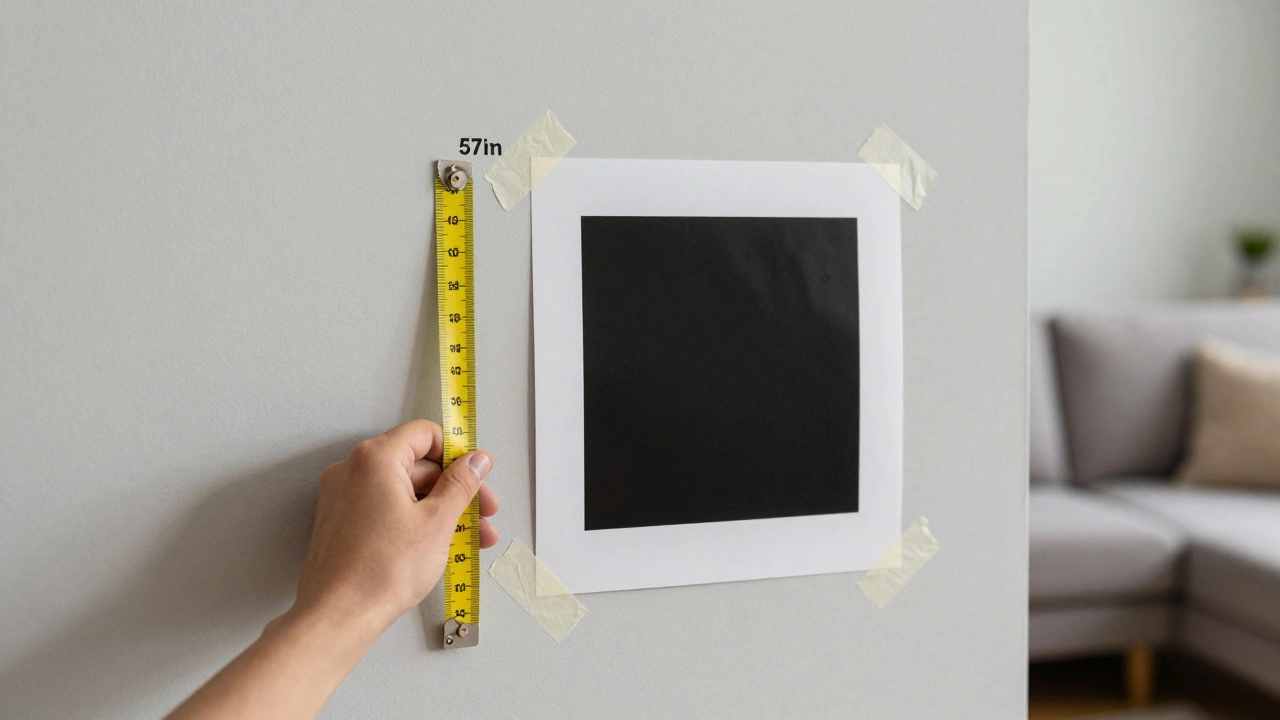
- Using a ruler on the wall - Use painter’s tape to mark the wall first. Then step back. Look at it from across the room. Does it feel right?
- Forgetting lighting - If you’re hanging art above a lamp or a dark corner, consider adding a picture light. It draws attention and adds depth.
Real-World Examples
Here’s what this looks like in practice:
- Living room - A 30-inch-tall landscape over a 20-inch sofa. The bottom of the frame is 8 inches above the sofa. That puts the center at 34 inches (from sofa) + 15 inches (half the frame) = 49 inches from the floor. Wait - that’s below 57. So you adjust: move the art up until the center hits 57. That means the bottom of the frame is now 42 inches from the floor. That’s 22 inches above the sofa - too much. So you compromise. Keep the bottom 7 inches above the sofa (27 inches from the floor). The center is 42 inches. It’s not perfect, but it’s close. And it looks right because it’s connected to the sofa.
- Empty hallway - A single 24-inch square print. Center at 57 inches. Bottom at 45 inches. Top at 69 inches. Clean. Balanced. No furniture. Perfect.
- Bedroom - Two 16x20 inch frames side by side. Total height: 20 inches. Center: 10 inches from top or bottom. Hang so the center is at 57. That means the bottom of each frame is at 47 inches. That’s above the bed (which is 24 inches tall), so the gap is 23 inches - plenty. It feels grounded.
Final Tip: Test Before You Nail
Don’t drill holes until you’re sure. Use painter’s tape to hold the frame in place. Step back. Sit on the couch. Stand across the room. Look at it for a full minute. Does it feel like it belongs? Or does it look like an afterthought?
Change the height. Try a different angle. Move it left or right. The 357 rule gives you a starting point. But your eye is the final judge. Trust it.
Art isn’t about rules. It’s about feeling. But a good rule helps you get there faster.
Is the 357 rule the same as the golden ratio?
No. The golden ratio is a mathematical proportion (about 1:1.618) used in art and design to create visual harmony. The 357 rule is purely about height - where to hang art so it’s at eye level. They’re not related. You can use both, but they solve different problems.
Can I use the 357 rule for mirrors or shelves?
Yes. The rule applies to any wall-mounted object that you want to see clearly. Mirrors, decorative shelves, clocks, or even wall sconces should have their center at 57 inches from the floor. This makes them easy to use and visually balanced.
What if my ceiling is low?
If your ceiling is under 8 feet, you might need to go a little lower - maybe 54 or 55 inches. But don’t drop it below 52. You still want it to feel connected to the viewer. Low ceilings don’t mean you sacrifice balance. Just adjust slightly.
Should I hang art in the kitchen or bathroom?
Absolutely. The 357 rule works everywhere. In the kitchen, hang art above the counter or sink. In the bathroom, above the vanity. Just make sure it’s moisture-resistant if it’s near water. The height rule stays the same - center at 57 inches.
Do I need to hang art on studs?
For heavy pieces (over 20 pounds), yes - use a stud finder. For lighter art, toggle bolts or heavy-duty picture hangers work fine. The 357 rule doesn’t care about the wall anchor - just the height.