Round Coffee Table Size & Fit Calculator
Enter Your Dimensions
Checking...
--Please enter dimensions above.
Visual Proportion Check
*Diagram is illustrative only
Enter your sofa and table dimensions to see if they work together.
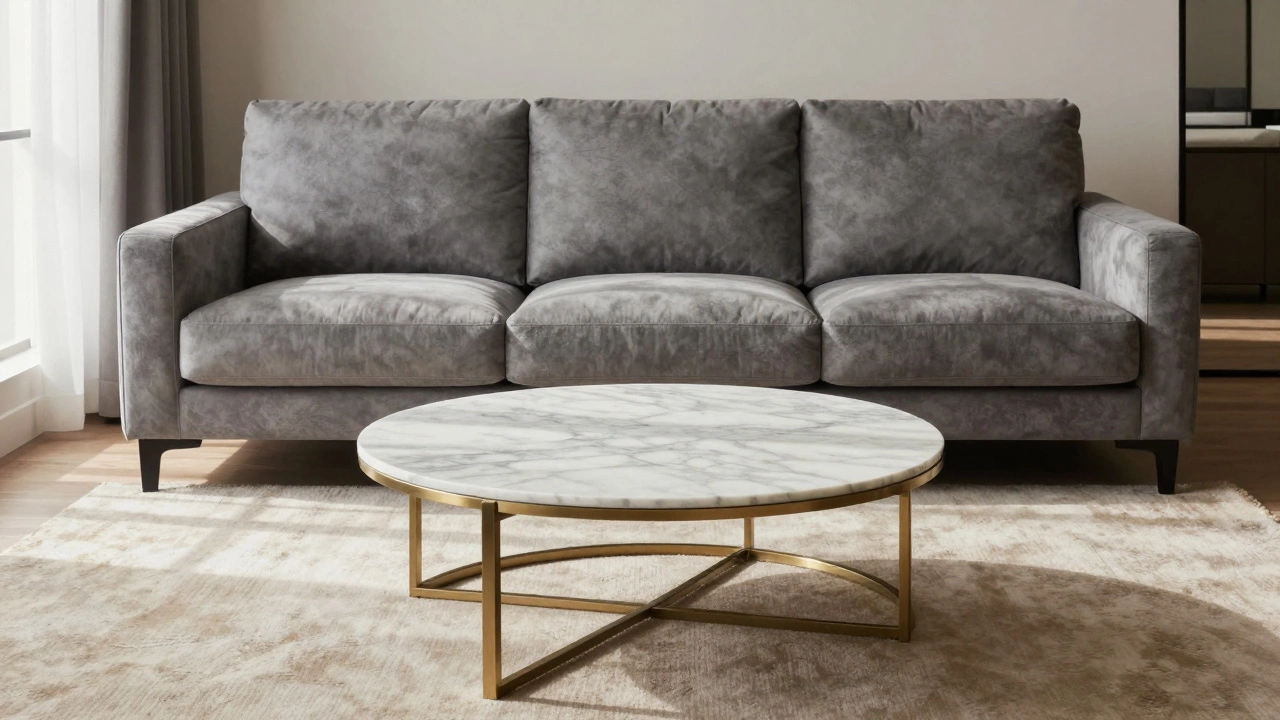
There is a quiet tension in every living room. On one side, you have the sofa-your anchor, your daily driver, the place where you collapse after work. On the other, the coffee table. It’s supposed to be functional, but it also defines the vibe. For decades, the default setting was rectangular: long, linear, and safe. But lately, round coffee tables are everywhere. They look sleek, they feel modern, and they promise safety for kids and pets. Yet, when you try to slide one in front of your standard three-seater sofa, something feels off. The scale seems wrong. The reach feels awkward. So, can you actually pull this off?
The short answer is yes. Absolutely. But it isn’t as simple as swapping shapes. Putting a round coffee table in front of a sofa requires a shift in how you think about space, flow, and proportion. If you just drop a small circle onto a rug under a large rectangle, you’ll end up with a void that looks like a mistake rather than a choice. To make it work, you need to understand the geometry of comfort.
Why the Shape Matters More Than You Think
We often choose furniture based on aesthetics first, function second. But in a living room, function dictates the aesthetic. A rectangular coffee table mirrors the shape of most sofas. It creates a visual line that extends the seating area, making the room feel wider and more structured. It’s predictable. Your eyes know where to go.
A round table breaks that line. It introduces curvature into a space dominated by straight edges. This can be beautiful-it softens the room, reduces visual clutter, and eliminates sharp corners that double as knee-bump hazards. However, circles don’t align with rectangles. When you place a round table in front of a sofa, you lose the "edge-to-edge" connection. The sides of the table hang over nothing, or worse, they get lost in the negative space between the sofa arms and the rest of the room.
This mismatch is why many people hesitate. It feels unbalanced. But balance isn’t about matching shapes; it’s about managing weight and flow. If you treat the round table as an island rather than an extension, the dynamic changes completely. You stop trying to force it to fit the sofa’s lines and start using it to create a distinct zone within the room.
The Golden Rules of Spacing and Scale
If you’re going to break the rectangular mold, you need to respect the math of movement. The biggest pitfall with round coffee tables is choosing one that is too small. Because a circle lacks the length of a rectangle, it often appears diminutive next to a substantial sofa. If your table is less than 36 inches in diameter, it will likely look like a side table that wandered into the middle of the room. It won’t hold enough drinks, books, or decor to justify its presence, and it will leave your guests reaching across empty air.
Here is the practical rule of thumb: Aim for a diameter that is roughly half to two-thirds the length of your sofa. If you have a standard 84-inch (7-foot) sofa, a round table between 40 and 56 inches in diameter is the sweet spot. Anything smaller feels timid; anything larger starts to block traffic flow.
Spacing is equally critical. You need enough room to sit comfortably without hitting the table, but close enough to use it. The ideal gap between the sofa seat and the table surface is 14 to 18 inches. This allows legs to tuck in slightly while keeping drinks within easy reach. Measure this before you buy. Stand up from your sofa and see if you can reach the center of the proposed table without leaning forward excessively. If you have to stretch, the table is too far away or too small.
Solving the "Empty Corner" Problem
When you place a round table in front of a sofa, you inevitably create triangular gaps at the front-left and front-right corners of the seating area. These are dead zones. In a traditional setup, these spaces might house floor lamps, plants, or simply open floor space. With a round table, these gaps can look unfinished if left empty.
You have two main strategies to fix this:
- The Cluster Approach: Instead of one large round table, use two or three smaller nested tables. One large round table paired with a smaller side table or a spherical accent piece fills those corners visually. This creates an organic, layered look that feels intentional rather than sparse.
- The Anchor Strategy: Keep the single round table but add vertical elements nearby. A tall floor lamp behind the sofa arm, or a potted plant in the corner of the room, draws the eye upward and outward, balancing the low, central mass of the round table. This prevents the eye from getting stuck in the empty triangular space.
Another trick is to use a rug to define the boundary. Ensure all four legs of the sofa (or at least the front two) and the entire base of the round table sit on the same rug. This ties the disparate shapes together into a single cohesive unit. Without a rug, the round table can float aimlessly, disconnected from the sofa above it.
Material and Visual Weight
Shape isn’t the only factor; material matters too. A thin, glass-top round table with delicate metal legs has very little visual weight. It disappears. This can work well in small apartments where you want to maximize the sense of space, but it might feel flimsy next to a heavy, upholstered sectional. Conversely, a thick slab of marble or solid wood commands attention. It anchors the room.
Consider the texture contrast. If your sofa is soft, plush velvet or linen, a hard, smooth stone table provides a nice tactile counterpoint. If your sofa is leather with clean lines, a wooden table with visible grain adds warmth. The key is to ensure the table doesn’t fight the sofa for dominance. If both are bold, the room becomes chaotic. Let one lead. Usually, the sofa leads because it’s larger, so the table should complement, not compete.
| Sofa Length | Recommended Table Diameter | Best Use Case |
|---|---|---|
| Up to 70 inches (Love Seat) | 24 - 32 inches | Small studios, cozy nooks |
| 70 - 84 inches (Standard 3-Seater) | 36 - 48 inches | Most average living rooms |
| 85+ inches (Sectional/Large Sofa) | 48 - 60 inches OR Clustered Tables | Open plan areas, family rooms |
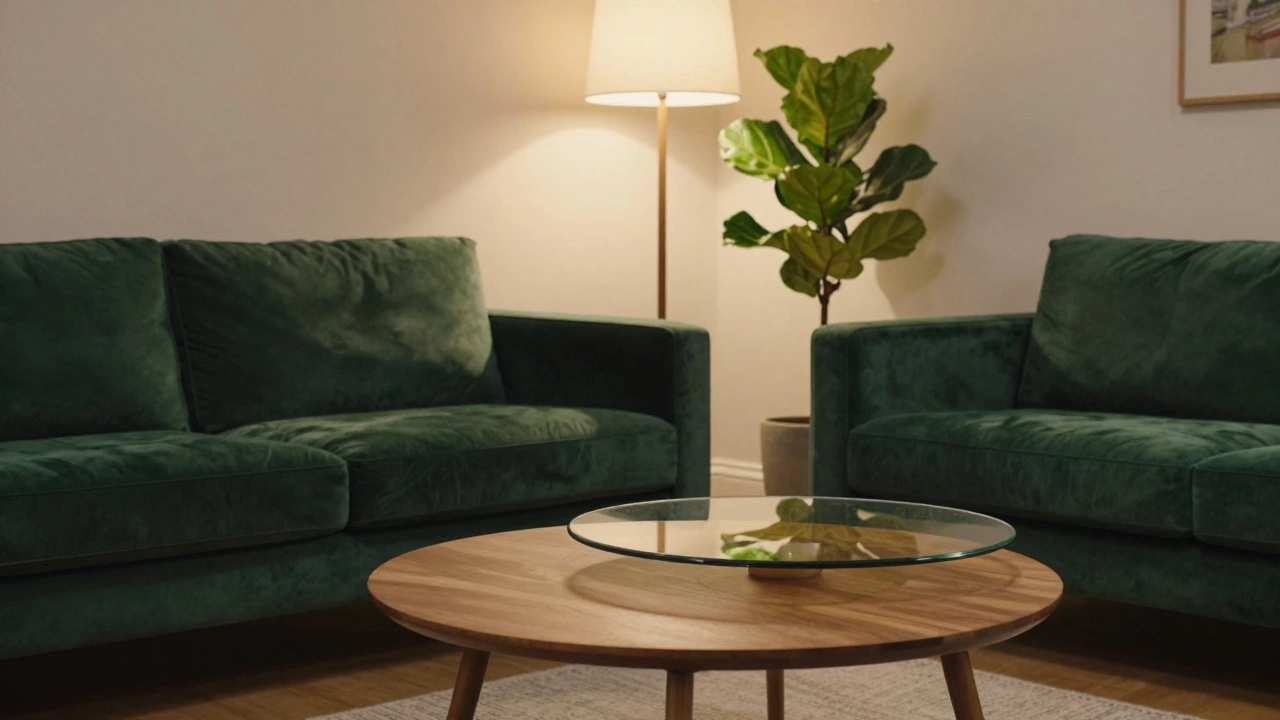
When a Round Table Is a Bad Idea
Not every living room is suited for a circular centerpiece. If your primary activity is working on a laptop at the coffee table, a round surface is frustrating. Laptops need flat, stable edges to prevent sliding. Books tend to tumble off curved edges unless you’re very careful. If you host frequent game nights or puzzle sessions, the lack of defined corners makes organizing pieces difficult.
Additionally, if your living room is narrow and deep (like a hallway), a round table can obstruct the natural path of travel. Rectangular tables can be aligned parallel to the wall to keep the walkway clear. A round table forces people to navigate around its circumference, which can feel constricting in tight spaces. In these cases, an oval table might be a better compromise-it offers some curve without the full obstruction of a circle.
Styling the Curve
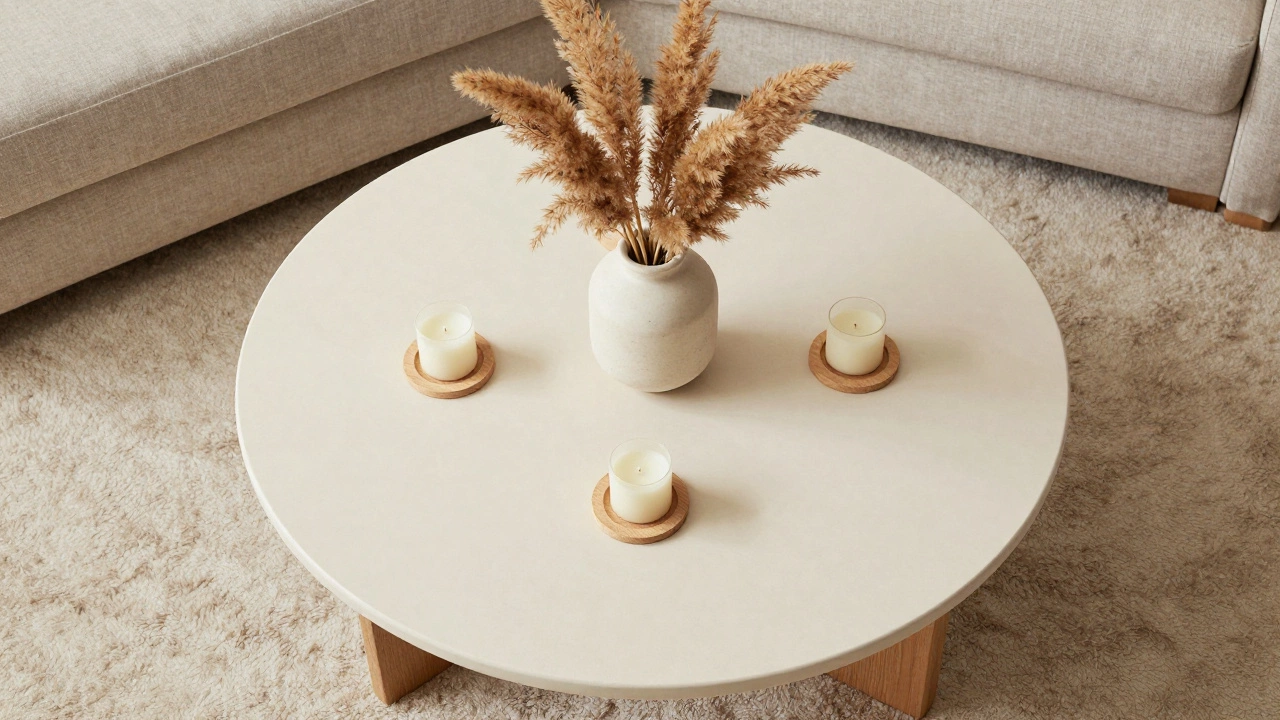
Once the table is placed, styling it differently than a rectangular table is crucial. On a rectangle, you typically arrange items in a row or a grid. On a round table, symmetry works best. Place a central vase or bowl in the exact middle. Then, arrange secondary items like candles or coasters in a circle around it. This reinforces the shape rather than fighting it.
Avoid placing tall, bulky items on the edge of a round table. They create visual imbalance because there’s no corner to "hide" them. Keep the perimeter clear to maintain the airy, open feel that makes round tables special. The goal is to highlight the table’s form, not cover it up.
Is a round coffee table safer than a rectangular one?
Yes, significantly. Round tables eliminate sharp corners, which are the primary cause of head and knee injuries in busy households. If you have young children or pets who run around the living room, a round table is a much safer choice. Just ensure the base is stable and weighted properly to prevent tipping.
How do I choose between a round and oval coffee table?
Choose a round table if you want to soften the room’s energy and prioritize safety and conversation flow. Choose an oval table if you need more surface area for dining or working but still want to avoid sharp corners. Oval tables bridge the gap between the functionality of rectangles and the softness of circles, making them ideal for narrow rooms.
Can I put a round coffee table in front of a sectional sofa?
It depends on the size. For a large L-shaped sectional, a single round table often looks too small and gets pushed into one corner. Instead, consider a cluster of two or three round tables of varying sizes. This fills the void created by the sectional’s angle and provides multiple surfaces for different seating areas.
What height should my round coffee table be?
The ideal height is 16 to 18 inches. It should be level with or slightly lower than your sofa seat cushion. If the table is higher than the seat, it looks awkward and is harder to use. If it’s too low, you’ll strain your back to reach it. Always measure your sofa seat height before buying.
Do round coffee tables make a room look smaller?
Not necessarily. In fact, they can make a room feel more open because they remove visual barriers. Rectangular tables create strong horizontal lines that can box in a space. Round tables encourage the eye to move around the room freely. However, if the table is too large for the space, it will dominate the floor plan and make the room feel cramped.