Shelf Triangle Rule Calculator
Arrange Your Items
Drag the items below to create a triangle on your shelf. Follow the triangle rule for perfect balance.
Result
Drag items to form a triangle
- One item is tall (12-20")
- One item is medium (6-10")
- One item is short (3-5")
- Items are spaced apart to form an invisible triangle
Ever stare at a shelf and feel like something’s off? Maybe the books look too heavy on one side. Or the decorative items feel scattered, like they’re fighting for attention. You don’t need to be an interior designer to fix this. There’s a simple, time-tested trick called the triangle rule for shelves-and it works every time.
What Exactly Is the Triangle Rule?
The triangle rule for shelves is a visual balance technique that uses three key items arranged in a triangular pattern to create harmony on a shelf. It’s not about symmetry. It’s about rhythm. You pick three objects-like a tall vase, a stack of books, and a small sculpture-and place them so they form an invisible triangle. The points of that triangle should be at different heights and spaced apart enough to let each item breathe.
This rule comes from basic design principles used in photography, painting, and architecture. The human eye naturally follows lines and shapes. A triangle draws the eye in a circular motion, keeping attention moving across the shelf instead of getting stuck on one spot. That’s why a shelf using this rule feels balanced, even if it’s not perfectly even.
Why Does It Work?
Your brain craves order, but not sameness. A shelf with all items the same height looks flat. One with random clutter feels chaotic. The triangle rule hits the sweet spot: it introduces variety while keeping control.
Think of it like a photo composition. If you place a tall object on the left, a medium one in the center, and a short one on the right, your eye moves from left to center to right-and back again. That’s visual rhythm. It’s calming. It feels intentional.
Studies in visual perception show that arrangements following triangular or zigzag patterns are remembered longer and rated as more appealing than straight lines or clusters. It’s why museum curators use this method to display artifacts. And why high-end retailers arrange their shelves this way.
How to Apply the Triangle Rule Step by Step
- Pick your three anchor items. Choose one tall, one medium, and one short. They don’t have to match. A ceramic pitcher, a stack of three hardcover books, and a small framed photo work perfectly.
- Place them in a triangle. Put the tallest item on one end (left or right). Put the medium item in the center or slightly off-center. Put the shortest on the opposite end. This creates three clear points.
- Fill in the gaps. Now add smaller items around the triangle-like a candle, a plant, or a stack of magazines. Keep them low and close to the shelf surface. Don’t let them compete with your three anchors.
- Step back and check. If your eye gets stuck on one spot, adjust. Maybe the tall item is too close to the edge. Or the short one is hidden behind a book. Move it slightly until the triangle feels natural.
Pro tip: Don’t overdo it. Three anchors are enough. Too many items turn your shelf into a cluttered attic.

Real-World Examples
Let’s say you have a bookcase in your living room. On the middle shelf:
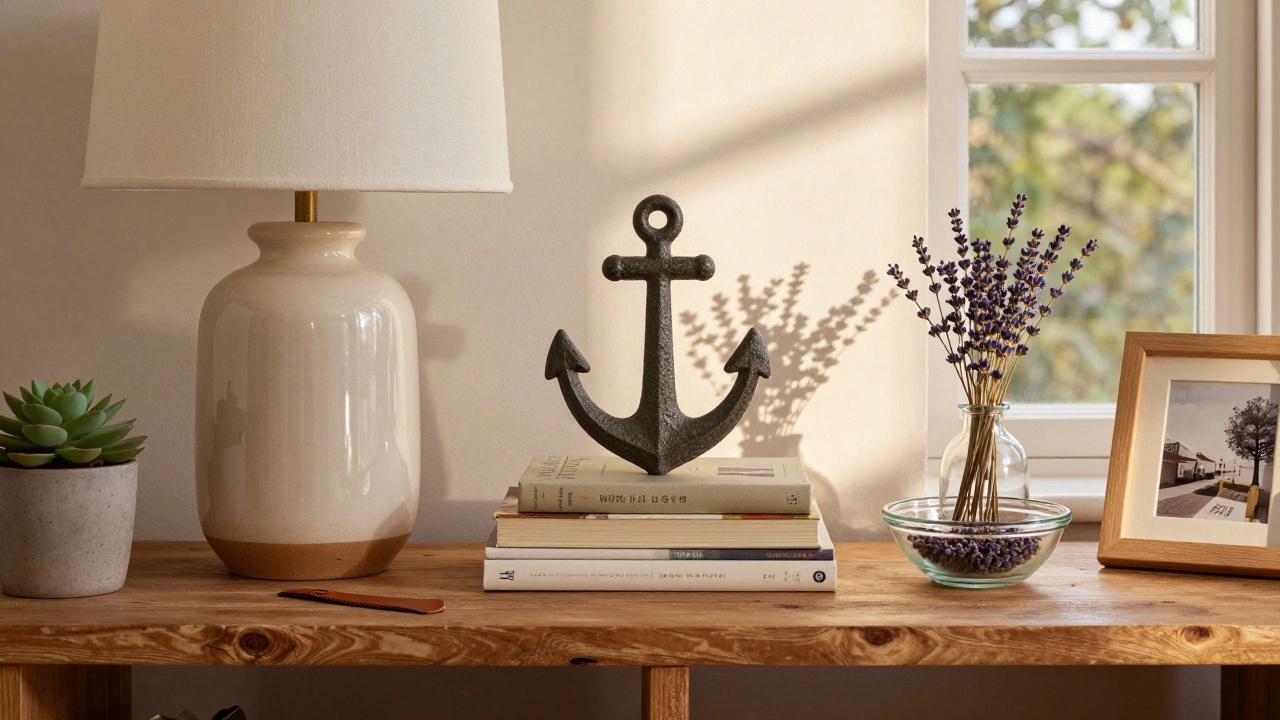
- Left: A 16-inch ceramic lamp (tall)
- Center: A stack of three art books (medium)
- Right: A 4-inch glass bowl with dried lavender (short)
Now add a small succulent near the lamp, a leather bookmark tucked under the books, and a single framed postcard leaning against the bowl. That’s it. The triangle holds everything together. No chaos. No emptiness.
Another example: A bedroom shelf above a nightstand.
- Left: A brass alarm clock (medium)
- Center: A stack of two novels and a journal (medium-tall)
- Right: A tiny crystal figurine (short)
Add a folded linen napkin under the books and a single tea candle beside the crystal. Instant warmth. No clutter.
Common Mistakes to Avoid
Even when people try the triangle rule, they mess it up. Here’s what not to do:
- Using four anchors. Four points make a square. Squares feel rigid. Triangles feel alive.
- Placing all items at the same height. That’s a line, not a triangle. It looks boring.
- Putting large items in the middle. The center should be the medium item. Big stuff on the sides anchors the look better.
- Ignoring negative space. Empty space is part of the design. Let your items breathe. Don’t pack every inch.
One more thing: Don’t force symmetry. The triangle rule is asymmetrical by nature. If you try to mirror it on both sides of the shelf, you’ll lose the rhythm. Let one side be heavier. Let the other be lighter. That’s what makes it feel real.

What If You Don’t Have Three Items?
You don’t need to own a fancy vase or a collection of sculptures. The triangle rule works with everyday stuff.
Instead of a tall item, use a stack of books. Instead of a short item, use a single keychain or a small photo. The key isn’t the object-it’s the height variation.
Here’s a quick cheat sheet:
| Position | Height | Examples |
|---|---|---|
| One End | Tall (12-20 inches) | Lamp, plant, vase, stack of 4 books |
| Center | Medium (6-10 inches) | Stack of 2-3 books, small sculpture, framed photo |
| Other End | Short (3-5 inches) | Candle, figurine, small bowl, single book |
Even if you only have books, you can still use the triangle rule. Stack them at different heights. Put one book flat on its spine, another on its edge, and a third standing upright. That’s your triangle.
Does It Work on All Shelves?
Yes. It works on floating shelves, bookcases, TV stands, bathroom vanities, and even kitchen open shelving. The rule doesn’t care about size or material. It cares about height variation and spacing.
On narrow shelves? Skip the tall item. Use two medium-height items and one short one. The triangle still forms-it’s just smaller.
On deep shelves? Use the front and back. Place the tall item in the back corner. The medium in the center front. The short item near the front edge. Depth adds dimension, not clutter.
The triangle rule is flexible. That’s why it’s lasted.
How This Changes Your Space
Once you start using the triangle rule, you’ll notice something: your shelves stop looking like storage. They start looking like displays. Like art.
People will comment. "Oh, I love how you arranged your books." They won’t know why. But they’ll feel it. That’s the power of subtle design.
It’s not about having expensive stuff. It’s about having intention. The triangle rule gives you that. It’s the difference between a shelf that looks like it was thrown together and one that looks like it was thought through.
And here’s the best part: you can change it every season. Swap the vase for a lantern. Trade the books for a travel journal. The triangle stays. The feeling stays. The shelf stays fresh.
Can I use the triangle rule on a single shelf, or does it need to be a whole bookcase?
You can use it on any shelf-single or multi-tiered. In fact, starting with one shelf is easier. Once you get comfortable with the rhythm, you can apply it to each level. But you don’t need to do all of them at once. One well-done shelf makes a bigger impact than five half-finished ones.
Do the three items have to be different types of objects?
Not at all. You could use three books of different heights, or three plants in varying pots. The rule is about height and placement, not variety. But mixing materials-wood, glass, ceramic, fabric-adds texture and depth. It’s not required, but it helps.
What if my shelf is too narrow for three items?
Then use two. Place a medium item on one side and a short item on the other. The space between them becomes the third point of the triangle. This is called a "broken triangle," and it still creates visual movement. It’s subtle, but it works.
Can I use the triangle rule for open kitchen shelves?
Absolutely. In fact, it’s perfect for kitchens. Use a tall glass jar for flour, a medium ceramic bowl for utensils, and a short stack of plates. It turns everyday items into a curated display. No more looking like a storage closet.
Is the triangle rule the same as the rule of thirds?
They’re related, but different. The rule of thirds divides a space into nine equal parts and places key elements along the lines or intersections. The triangle rule focuses on arranging three items to form a shape. The triangle is more intuitive for shelves. The rule of thirds is better for photos or room layouts. Many designers use both together.