Bedroom Furniture Placement Calculator
Layout Analysis
Where you put your furniture in a bedroom isn’t just about making it look nice-it affects how you sleep, move, and even feel in the space. A poorly arranged room can make mornings frustrating and nights restless. The right setup? It makes the room feel bigger, calmer, and actually usable. So how do you decide where to put everything? It’s not guesswork. It’s about measuring, observing, and prioritizing what matters to you.
Start with the bed
The bed is the anchor. Everything else flows from it. Most people put it against the center of the longest wall. That makes sense-it gives you space on both sides and a clear path to the door. But if your room is narrow, try putting the bed at the foot of the room, perpendicular to the wall. Suddenly, you’ve got walking space on both sides and a more open feel. Don’t just plop it where it looks good. Check the door swing. If your door opens inward and hits the nightstand, you’ve got a problem. Move it. A few inches can fix it.
Also, avoid putting the bed directly in line with the door. It’s not about superstition-it’s about flow. When you walk in, you shouldn’t be staring straight at the headboard. It feels exposed. Angle it slightly, or put a dresser or chest between the door and bed to break the line of sight. That creates a sense of privacy even in small rooms.
Measure everything
You can’t eyeball this. A queen bed is 60 inches wide. A standard nightstand is 20 to 24 inches. Add a lamp, a book, and a phone charger, and you need at least 24 inches of clearance on each side. If your room is only 10 feet wide, and the bed takes up 6 feet, you’ve got 2 feet left on each side. That’s barely enough to walk around. You need at least 24 inches of walking space around furniture. That’s 2 feet. Not 18. Not 20. 24.
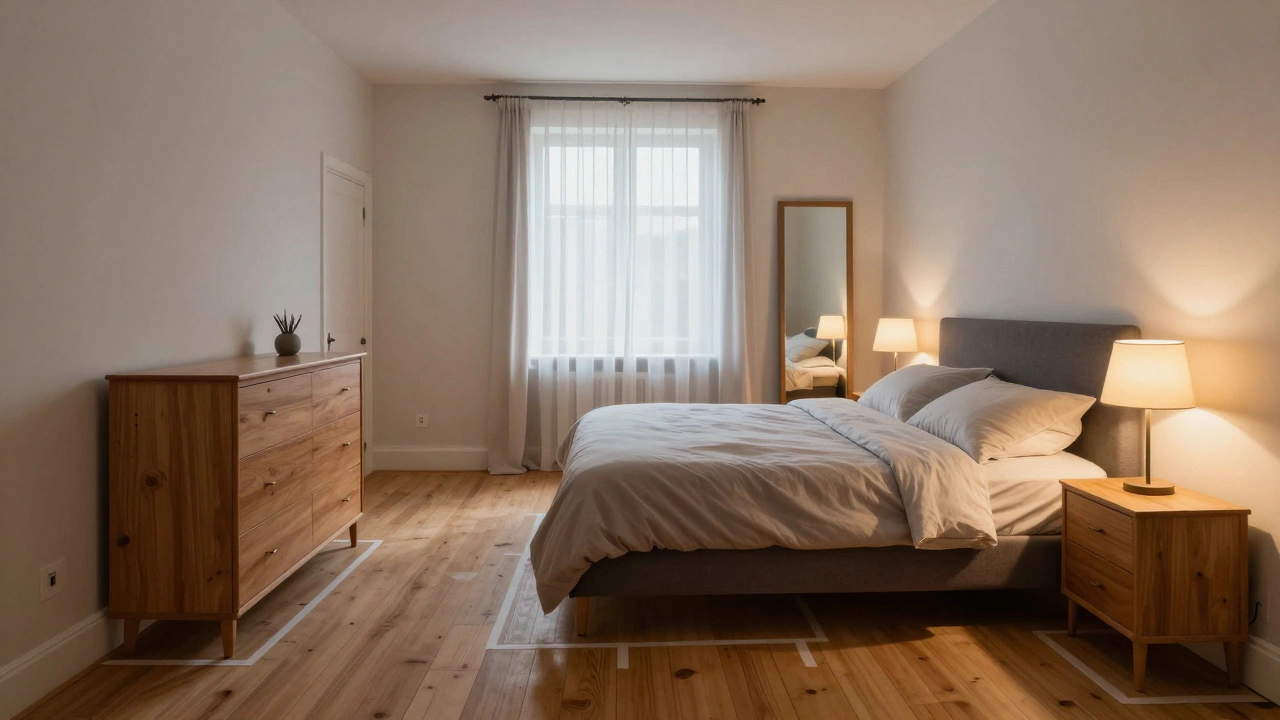
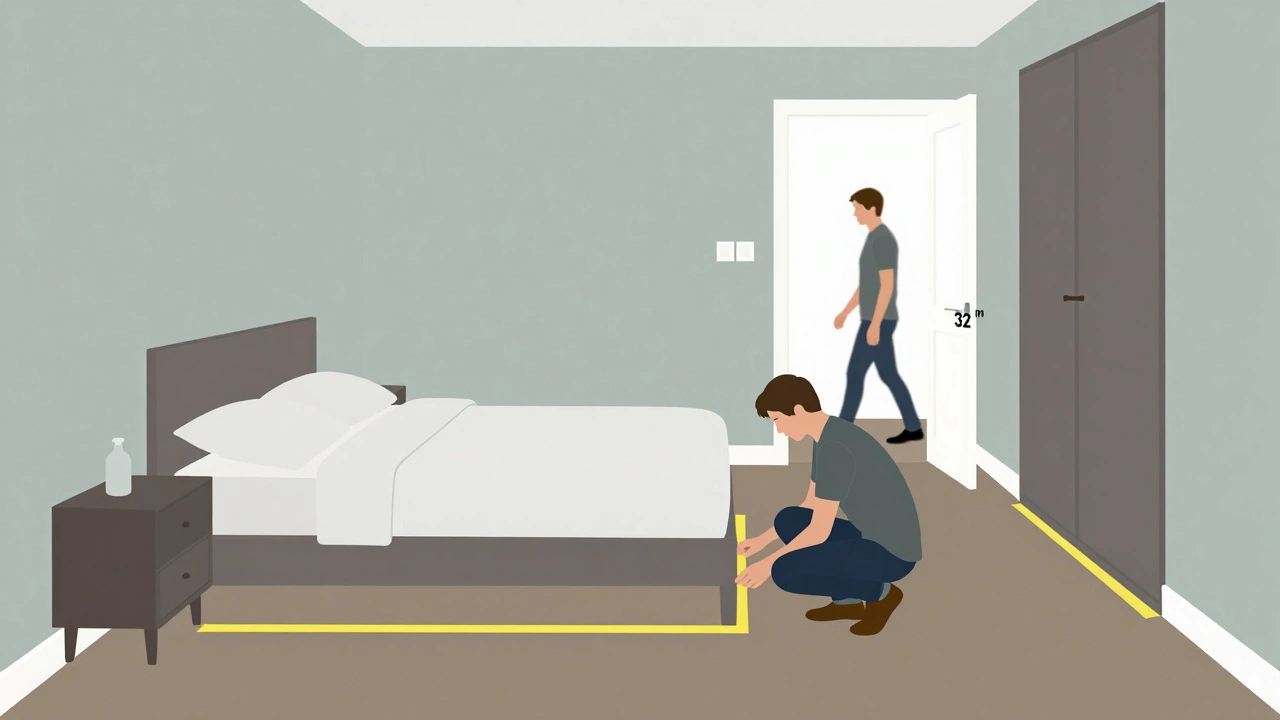
Use painter’s tape to mark out the bed, dresser, and nightstands on the floor. Walk around. Sit on the bed. Open drawers. Try to get to the closet. If you’re bumping into things or squeezing past, it’s not working. Move it. This step saves you from buying something that doesn’t fit and then realizing you can’t open the closet door.
Think about the door and closet
The door and closet are fixed. Your furniture has to work around them. If your closet door swings into the room, don’t put a dresser or chair where it hits. Same with the bedroom door. If it opens toward the center of the room, keep the path clear. A 32-inch-wide path is the minimum for comfortable movement. That’s about the width of a standard interior door.
For closets, leave at least 24 inches of space in front of the door. You need room to open it fully and pull out clothes. If you’ve got a walk-in, you can be more flexible. But if it’s a standard reach-in, that space matters. A 30-inch-deep dresser placed right in front of it? You’ll be yanking clothes out with one hand while holding the door open with the other. Not fun.
Balance the room
Rooms feel off when one side is heavy and the other is empty. If you’ve got a tall dresser on the left, balance it with something on the right. A lamp, a small bookshelf, a chair with a throw on it. Doesn’t have to match. Just have similar visual weight. A single nightstand on one side of the bed makes the room feel lopsided. Two is better. Or, if you only have space for one, put a tall mirror or vertical art piece on the other side to pull the eye up.
Don’t try to match everything. That’s a design trap. A mismatched pair of nightstands can look intentional and cozy. What you want is rhythm. One piece on the left, one on the right. A lamp, a plant, a stack of books. Even if they’re different, they create a sense of harmony.
Lighting and outlets matter
You’re not just arranging furniture-you’re arranging access. Where are the outlets? Most bedside lamps plug into outlets on the wall behind the bed. If your bed is 12 inches from the wall and the outlet is 6 inches above the floor, you’re going to need a long cord or an extension. That’s messy. Plan ahead. If the outlets are on the wrong side, consider a battery-powered lamp or a wall-mounted reading light.
Also, think about task lighting. If you read in bed, you need a lamp that shines over your shoulder, not into your eyes. A swing-arm lamp on the wall works better than a bulky table lamp. If you’ve got a desk in the bedroom, make sure it’s near an outlet for your computer and charger. Don’t assume you’ll find one later. Most older homes have only one or two outlets per wall.
Leave breathing room
People fill rooms because they think more stuff = more comfort. It’s the opposite. A bedroom should feel like a retreat, not a storage unit. If you’ve got a dresser, a nightstand, a chair, a rug, and a TV stand, you’re probably too full.
Ask yourself: What do I actually use every day? The bed. Maybe one nightstand. A lamp. The closet. Everything else? Could it go? A bench at the foot of the bed? Only if you use it to put clothes on. A desk? Only if you work from bed regularly. If not, it’s just taking up space.
Leave at least 18 inches of open floor around the bed. That’s enough to move without tripping. That’s enough to vacuum. That’s enough to feel like you can breathe.
Test it out
Don’t just set it and forget it. Live with it for a week. Notice what you bump into. What you trip over. What feels awkward. Maybe the chair looks nice in the corner but you never sit in it. Move it. Maybe the nightstand is too close to the door and you keep knocking your coffee off it. Shift it 6 inches. Small changes make big differences.
Try sleeping on the other side of the bed. See how the light hits in the morning. Does the window glare in your eyes? Maybe you need curtains. Does the closet door block the path to the bathroom? Maybe you need to rearrange the dresser.
There’s no perfect layout. There’s only the one that works for your body, your habits, and your space. The best bedroom isn’t the one that looks like a magazine photo. It’s the one where you wake up without thinking, where you get dressed without bumping into anything, and where you feel calm when you walk in.
Start with the bed. Measure everything. Respect the door and the outlets. Balance the room. Leave space. Test it. Adjust. That’s it.